|
|
| |
|
|
| |
|
|
|
|
| |
|
|
|
|
|
|
|
|
|
|
|
|
|
|
| |
|
|
| |
|
|
| |

ENERGY EFFICIENCY
UPGRADES
INCREASE MARKET VALUE OF
HOMES
“Evidence of Rational
Market Values for Home
Energy Efficiency,”
Rick Nevin and Gregory
Watson, Appraisal
Journal, October 1998.
(Adobe Acrobat Format)
This study
demonstrates the
increased value of
energy-efficient homes,
assigning estimated
incremental home value.
"More
Evidence of Rational
Market Values for Home
Energy Efficiency"
Appraisal Journal,
October 1999
| |
|
|
| |
 |
| |
The advantages
of an We LLC Home are: |
|
| |
-
Insect and Mold Resistant
-
High Energy Efficiency Components
-
Increased Resale Values
-
Decreased Building Time
-
A True Green Product
-
Decreased Mortgage & Payment Rates
-
Potential Energy Tax Credits
-
Reduced Energy Costs
-
Increased Life Expectancy of Building
-
High Wind Load Survivability
-
Reduced Thermal Loss
-
Reduced Insurance Rates
|
|
| |
|
|
| |
|
|
|
|
|
| |
|
|
A
peer-reviewed study
published in The
Appraisal Journal shows
that homebuyers are
willing to pay
substantially more for
energy-efficient homes.
This study, titled
"Evidence of Rational
Market Values for Home
Energy Efficiency,"
concludes that people
are willing to fully pay
for the monthly fuel
savings of energy
efficient homes with
higher monthly mortgage
payments" which
translate into higher
home values. Thus,
homebuilders and
homeowners who invest in
energy efficiency can
expect to recover the
market value of their
energy efficiency
investments when they
sell their homes.
The ICF study
reviews published
research on energy
efficiency and home
values, and presents an
extensive statistical
analysis of American
Housing Survey (AHS)
data. The published
research shows that
market values for energy
efficient homes appear
to reflect a rational
trade-off between
homebuyers' fuel savings
and their after-tax
mortgage interest costs.
The ICF statistical
analysis explicitly
tests this "rational
market hypothesis"
against National AHS
data for 1991, 1993, and
1995, and metropolitan
statistical area data
for 1992 through 1996.
Both of these distinct
AHS samples provide data
on home characteristics
(including home value,
number of rooms, square
feet, lot size, and
utility bills) as
reported by homeowners
in lengthy interviews
with the Census Bureau.
The study presents
separate statistical
results for each year,
for detached and
attached homes, and for
detached housing with
different heating fuels
(gas, electric, or fuel
oil).
These statistical
results support the
conclusion
"That
home value increases by
$20 for every $1
reduction in annual
utility bills",
consistent with
after-tax mortgage
interest rates of about
five percent from 1991
through 1996.
This research was
conducted for the U.S.
Environmental Protection
Agency (EPA) ENERGY
STAR® Homes program.
ENERGY STAR® homes use
at least 30% less energy
than a Model Energy Code
home while maintaining
or improving indoor air
quality and increasing
comfort in the home. EPA
estimates that the cost
to upgrade a new home to
ENERGY STAR® levels can
range from $2,000 to
$4,000, and that a
typical ENERGY STAR®
home reduces utility
bills by $420 per year.
The ICF study indicates
that $420 in annual
utility savings will add
about $8,400 to the
market value of an
ENERGY STAR® home (or to
any equally efficient
home), or two to four
times the builder's
upgrade costs.
The study should
also encourage
homeowners to consider
energy efficiency
upgrades for existing
homes. An important
conclusion from this
research is that
homeowners "can profit
by investing in energy
efficient homes even if
they are uncertain about
how long they might stay
in the home. If their
reduction in monthly
fuel bills exceeds the
after-tax mortgage
interest paid to finance
energy efficiency
investments, then they
will enjoy positive cash
flow for as long as they
live in their home and
can also expect to
recover their investment
in energy efficiency
when they sell their
home." This research
also has significant
implications for home
appraisers, mortgage
lenders, and housing
assistance programs at
the federal, state, and
local levels.
Written by: The
Appraisal Journal by
Rick Nevin and Gregory
Watson :
“Evidence of Rational
Market Values for Home
Energy Efficiency,”
Rick Nevin and Gregory
Watson, Appraisal
Journal, October 1998.
(Adobe Acrobat Format)
This study
demonstrates the
increased value of
energy-efficient homes,
assigning estimated
incremental home value.
" More
Evidence of Rational
Market Values for Home
Energy Efficiency"
Appraisal Journal,
October 1999
|
|
| |
|
|
|
|
|
|
|
|
|
|
|
|
|
|
|
|
|
|
|
|
|
|
|
|
|
|
| |
|
|
| |
How
much more would your conventional stick
built home be worth if it was an "We LLC" manufactured SIPs
home product. |
|
| |
|
|
| |
Using a 2,000 square
foot home constructed by We
Et. al., which has an average
heating/cooling bill of $35.00 a month; and
a similar size traditional built stick built
home with an average heating/cooling bill of
$145.00 a month, you save $110.00 a month in
energy costs; or an overall savings of
$1,320.00 a year in energy costs. |
|
| |
|
|
| |
Using the criteria in
the
U.S. Environmental Protection Agency (EPA)
report which was published in the
Appraisal Journal, you take the
$20 for every $1
reduction in annual utility bills
and multiply it by $1,320.00 and you get an
increased home resale value of
$26,400.00.
If you saved even more in energy savings
in a year, the resale value of your home
will do nothing but increase.
"Doesn't it make sense to maximize the
value of your single largest asset" |
|
| |
|
|
| |
Give us a call at
1-928-717-9702
to see if we can help you make an additional
$26,400.00 or more when you sale your home,
and let you save several thousand dollars a
year in energy cost while you own it. |
|
| |
|
|
| |
|
|
| |
|
| |
|
|
| |
| |
|
It's not that the builder is intentionally misleading
his client or associate, but that he's just following common practice. In
reality, this reasoning doesn't take into account all the other components that
go into making a wall: wood or steel studs every 16" or 24", bracing, nails or
screws, wiring and switch boxes - any number of things that are not insulation,
and in all likelihood, have R-values that fall well short of the stated R-24.
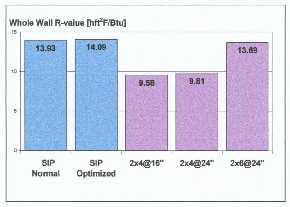 A new study by the Oak
Ridge National Labs (ORNL) proves that a 4-inch SIP wall outperforms 2"x4" stick
and batt construction, and even edges out 2"x6" construction in terms of thermal
performance. Because SIPs are the structural elements, there are no studs or
braces to cause breaks in the insulative action. The end result is a more
comfortable, energy efficient structure that performs up to spec in real-world
conditions. Unlike stick and batt construction, which can be subject to poorly
installed - even missing - insulation, the nature of SIPs is such that the
structural and insulative elements are joined as one. There are no hidden gaps,
because a solid layer of foam insulation is integral to panel construction. A new study by the Oak
Ridge National Labs (ORNL) proves that a 4-inch SIP wall outperforms 2"x4" stick
and batt construction, and even edges out 2"x6" construction in terms of thermal
performance. Because SIPs are the structural elements, there are no studs or
braces to cause breaks in the insulative action. The end result is a more
comfortable, energy efficient structure that performs up to spec in real-world
conditions. Unlike stick and batt construction, which can be subject to poorly
installed - even missing - insulation, the nature of SIPs is such that the
structural and insulative elements are joined as one. There are no hidden gaps,
because a solid layer of foam insulation is integral to panel construction.
By contrast, state-of-the-art technical analysis of
whole wall performance indicates that the losses in a stud wall are much greater
than you might think: on average, the other standard components in stick and
batt construction can reduce R-values in as much as 30% of the wall area.
Fortunately, that's not the case with structural insulated panels. The ORNL
study found that SIPs perform at approximately 97% of their stated R-value
overall, losing only 3% to nail holes, seams, splines, and the like. Wiring
chases are precut or preformed into the foam core, providing a continuous layer
of insulation keeping the elements at bay and the interior free of drafts and
cold spots.
A SIP wall also outperforms stick and batt when it
comes to maintaining consistent interior temperatures, and that translates to
improved occupant comfort. As shown in the graph below, the interior surface
temperature of frame construction drops precipitously at every stud, while the
SIP wall remains consistent across its entire surface. No temperature dips mean
improved occupant comfort, regardless of where you are in the room. That's a big
part of what people are talking about when they say they can immediately "feel
the difference" in a SIP-built residential or commercial space. With SIPs,
thermal efficiency and comfort are built in at the factory, and now the lab
results prove it.
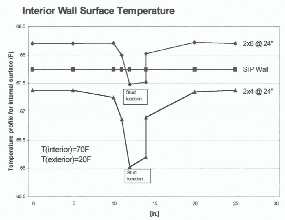
Interior surface temperature comparisons indicating
constant temperature for SIP wall and reductions in temperature at stud
locations for 2"x 4' and 2" x 6" wood frame walls (ORNL).
|
|
|
|
|
|
| |
|
|
| |
| |
|
R-Values of EPS Core SIPs
(Calculated R-Values)
R-Values of EPS Core SIPs
|
EPS Core Thickness |
3 5/8” |
5 5/8” |
7 3/8” |
9 3/8” |
12 3/8” |
|
R-Value @ 75° F |
15.34 |
23.04 |
29.77 |
40.36 |
49.02 |
|
@ 40° F |
16.57 |
26.26 |
32.28 |
43.80 |
53.23 |
|
@ 25° F |
17.15 |
27.16 |
33.46 |
45.42 |
55.21 |
Calculated R-Values are for a
generic We Structural Insulated Panel, using
Type I, Expanded Polystyrene Foam that meets ASTM C – 578,
calculated per ASHRAE published values at 3.85 per inch at 75°
F, 4.19 at 40° F and 4.35 at 25°.
Mean temperatures
are established for differing regions, and occupancies.
Please consult your local jurisdiction for interpretation of
Regional or National Model Energy Code Requirements.
A one-inch increase in wall insulation increased home value
by $1.90 per square foot; a one-inch increase in ceiling
insulation increased home value by $3.37 per square foot. High
quality (energy-efficient windows) increased home value by
$1.63 per square foot. (Corgel, Goebel, and Wade. "Measuring
Energy Efficiency for Selection and Adjustment of Comparable
Sales." The Appraisal Journal, 1982, pp 71-78.)
|
|
|
|
|
|
| |
|
|
| |
| |
|
Higher Resale Value
Studies conducted since the
early 1970's have consistently concluded that energy-efficient homes earn a
higher resale price than average homes. This means that purchasing an ENERGY
STAR qualified new home isn't just a smart investment today, but it will
also pay significant dividends in the future.
| Time Period |
Key Finding on Increased Value |
| 1970-75 |
The 1974 spike in relative cost of fuel oil
raised the price differential between gas- and oil-heated houses to $761
in 1974 and up to $4,597 in the first half of 1975. |
| 1971-78 |
A one-inch increase in wall insulation
increased home value by $1.90 per square foot; a one-inch increase in
ceiling insulation increased home value by $3.37 per square foot. High
quality (energy-efficient windows) increased home value by $1.63 per
square foot. (Corgel, Goebel, and Wade. "Measuring Energy Efficiency for
Selection and Adjustment of Comparable Sales." The Appraisal Journal,
1982, pp 71-78.) |
| 1978 |
Home value increased by about $20.73 for every
$1.00 decrease in annual fuel bills. |
| 1978-79 |
Value of energy-efficient homes (with lower
structural heat loss) was $3,248 higher than inefficient homes. |
| 1980 |
Home value increased by $2,510 for each one
unit increase in energy efficiency. |
| 1982 |
Home value increased by $11.63 per $1.00
decrease in fuel expenditures needed to maintain a house at 65o
F in an average heating season. |
| 1983-85 |
Home value increased by $12.52 per $1.00
decrease in electric bills, consistent with home buyers discounting
savings at after-tax mortgage interest rate. |
|
|
|
|
|
|
| |
|
|
| |
|
|
| |
|
|
| |
|
|
|
|
|
|
|
|
|
|
|
|
|
|
|
| |
| |
|
|
| |
| |
|
|
| |
- Sips Homes For Sale
- Sips Buildings For sale
- Sips Homes Manufacturing
- Sips Homes Builders in Arizona
- Expanded PolyStyrene
(EPS) Sips Homes
For
sale
- Sips Home Manufacturers
- Arizona Sips Homes For Sale
- Sips Home Contractors
- Arizona service businesses for sale
- Sips Home Multi family and Apartment
Manufacturers
- Du-Plexes, Tri-Plexes and Four-Plex unit
Sips Homes
- Arizona Sips Homes Construction Companies
- Sips Homes, Sips Houses and Sips Multi Family
Homes
- SIPs Homes, Sip Houses, PolyStyrene
Homes & Houses for sale
- Expanded PolyStyrene
(EPS) & Steel Framed
Commercial Buildings for sale
- Sips Home Developments
- Sip Manufacturers
|
Contact form: Please
provide the following contact information; |
Sips Home Manufacturers.. Sips Homes
for sale.. SIPs Buildings
for sale,
|
|
| |
|
|
| |
|
|
| |
|
|
| |
11-6-07 |
|
| |
|
|
|
|
|
| |
|
|
|
| |
|
|
|
|
|
|
| |
|
|
| |
Are Structural Insulated Panels More Expensive?
~
Building with SIPs generally costs about the same as Building with wood frame construction, when you factor in the labor savings resulting from shorter construction time and less job-site waste. Other savings are realized because less expensive heating and cooling systems are required with SIP construction.
|
|
| |
|
|
| |
SIPs Homes Out Perform Traditional "Stick Built"
~
SIP Buildings are vastly more energy efficient, stronger, quieter, and more draft free than other Building systems, such as stud framing with fiberglass insulation. Fiberglass is sometimes used for furnace filters because air moves through so freely. Rigid insulation is used as solid component insulation in almost every industry for its inherent efficiency and lack of air movement. These attributes are built right into a SIP Building. Less air leakage means fewer drafts, less noise, lower energy bills, and a much more comfortable indoor environment. |
|
|
|
|
|
Save
construction time
and
"MONEY"
on your "CONSTRUCTION
LOANS" ~
SIPs Homes
construction also saves costly labor
hours. A project using stick frame
construction may take several weeks with
a 4-person crew, but will take as little
as 3 days, with the same crew, using our
SIPs Homes system.
What makes SIPs even
better is the wire chases which are
factory milled in the EPS (Expanded Poly
Styrene) insulation, so wiring is as
easy as just fishing the wiring through.
Insulation costs and installation are
also a thing of the past; the
EPS
(Expanded PolyStyrene) replaces the
normal insulation and gives a better
long-wall insulating value and
performance with minimal thermal drift. |
|
|
|
|
| |
|
|
|
Some
of the advantages
of a We Home are: |
|
| |
-
Insect and Mold Resistant
-
High Energy Efficiency Components
-
Increased Home Resale Values
-
Decreased Building Time
-
A True Green Product
-
Decreased Mortgage & Payment Rates
-
Potential Energy Tax Credits
-
Reduced Energy Costs
-
Increased Life Expectancy of Building
-
High Wind Load Survivability
-
Reduced Thermal Loss
-
Reduced Insurance Rates
-
Higher Overall Resale Value
-
Reduced Costs For Heating and Cooling
Equipment
|
|
|
|
|
| |
|
|
| |
 |
|
| |
|
|
| |
 |
|
| |
|
|
|
|
|
|
|
|
|
| |
|
|
| |
|
|
|
|
| |
|
|
|
|
|
|
|
|
|
|
|
| |
|
|
| |
|
|
| |
|
|
|
|
|
|
|
|
| |
|
|
| |
|
|
| |
|
|
| |
|
|
| |
|
|
| |
|
|
| |
|
|
| |
|
|
| |
|
|
| |
| |
| |
|
|
| |
| |
|
|
| |
| |
|
Real Estate Financing Available in:
Alabama, Alaska, Arizona, Arkansas, California, Colorado,
Connecticut, Delaware, Florida, Georgia, Idaho, Illinois,
Indiana, Iowa, Kansas, Kentucky, Louisiana, Maine,
Maryland, Massachusetts, Michigan, Minnesota, Mississippi,
Missouri, Montana, Nebraska, Nevada, New Hampshire, New Jersey,
New Mexico, New York, North Carolina, North Dakota, Ohio,
Oklahoma, Oregon, Pennsylvania, Rhode Island, South Carolina,
South Dakota, Tennessee, Texas, Utah, Vermont, Virginia,
Washington, West Virginia, Wisconsin, Wyoming |
| |
|
Please contact me at
for all of your real estate financing
needs |
| |
|
|
|
| |
|
|
|
|
|
|
|
|
|
|
|
|
|
|
|
|
|
|
|
|
|
|
|
| |
|
|
|
|
 |
|
|
|
|
|
|